• CarbSens: Vascular response → early
• SMBG: Blood → accurate but not continuous
CarbSens does not measure glucose directly. It captures real‑time physiological reactions after meals — autonomic and vascular changes — which shift before and after glucose movement. CarbSens analyzes these time‑series patterns to study features associated with downward glucose trends.
◆CarbSens は CGM の代わりではない
・CGM:間質液 → 遅れる
・CarbSens:血管応答 → 早い
・SMBG:血液 → 正確だが連続測定できない
この三層構造の中で、CarbSens は血糖値そのものではなく、 食後に身体で起きる“生体反応の変化”を脈波センサーでリアルタイムで捉えるレイヤーに位置づけられます。 これらの反応は血糖値の前後で変動するため、CarbSens はその時系列パターンを解析し、 低血糖方向の変化に関連する特徴的なパターンを検出する研究を行っています。
CarbSens is not a medical device. Individual variability should be expected.
CarbSensは 医療機器ではありません、個人差を前提にご利用ください。
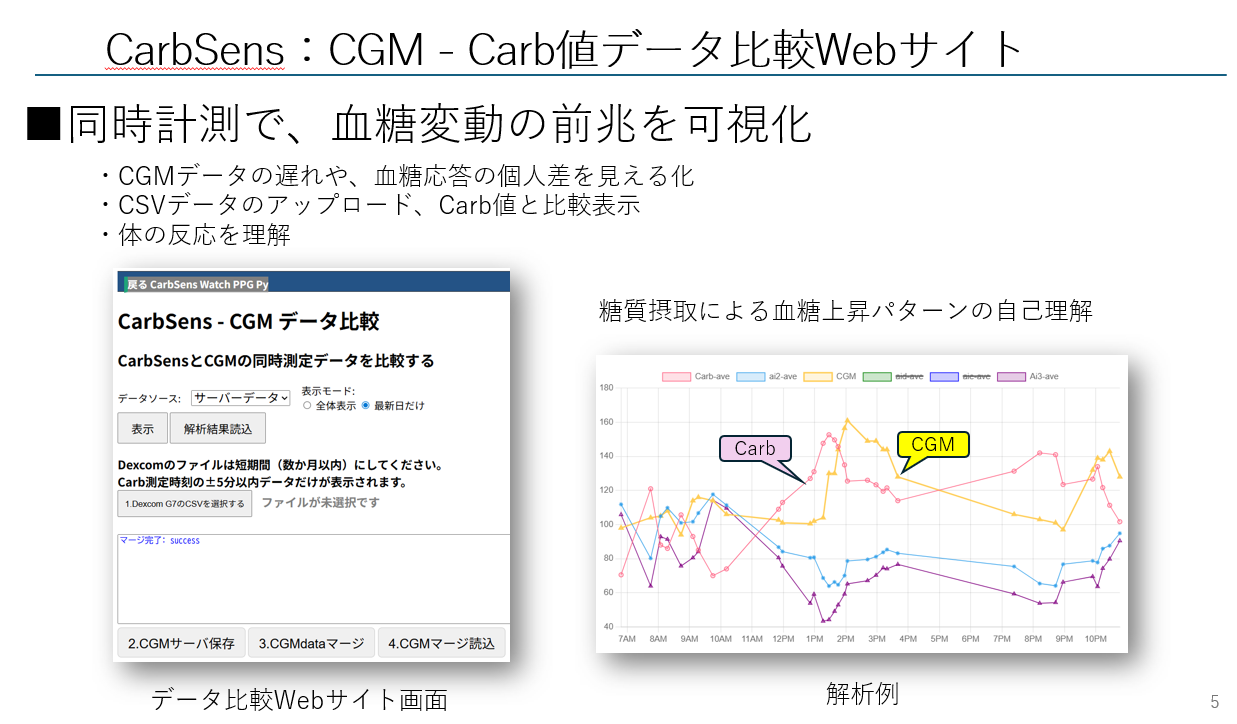
Figure: Web app for CGM–CarbSens data comparison
Dexcom CSV data can be uploaded to the web app.CarbSens pulse-wave data and CGM glucose data are displayed on the same timeline, making CGM time lag visible.
What happens in the body after meals:
• Rise in glucose
• Insulin secretion (parasympathetic activation)
• Vascular dilation (parasympathetic response linked to insulin action)
• PW (pulse width) changes
These processes are visualized as pulse‑wave features in continuous monitoring.
CarbSens shows how the body reacts before glucose moves.
図:データ比較サイトwebアプリ紹介
Dexcom の CSV データをアップロードすると、CarbSens の脈波データと CGM 血糖データを同じタイムライン上に重ねて表示、タイムラグを可視化します。
食後に身体で起きている:
・血糖値の上昇
・インスリン分泌(副交感神経がスイッチを押す)
・血管拡張(副交感神経の反応 → インスリン作用が連動)
・PW(パルス幅)の変化
これらが 連続モニタリングでどのように推移するか を、
脈波特徴量として可視化したものです。
「血糖が動く前に、身体はこう動いている」 という 原因→結果の流れ を、血管拡張・収縮の葛藤状態をぜひ自分のデータで眺めてみてください。
🟦 What CarbSens Measures
What “carbohydrate‑response monitoring” captures
CarbSens calibrates pulse‑wave features against glucose trends.It detects physiological reactions that shift before and after glucose changes.
① Insulin‑related responses before and after carbohydrate intake
Meal intake triggers insulin secretion around the time glucose begins to rise.This leads to vascular dilation, increased heart rate, and later a return of both glucose and HR toward baseline.
② Peripheral vascular reactions (changes in vascular tone)
Before glucose moves, autonomic balance (sympathetic ↔ parasympathetic) shifts,causing vessel constriction or dilation — detectable in pulse‑wave features.
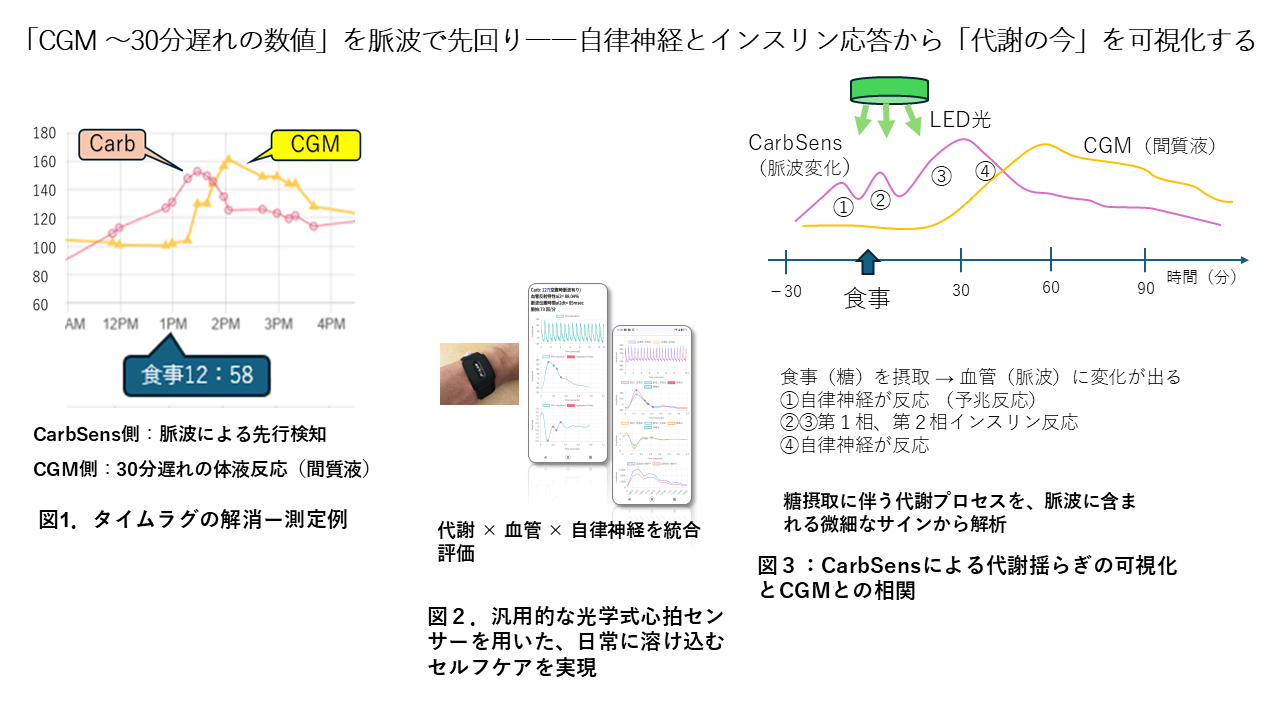
Figure: Visualizing CGM’s ~30‑minute delay — principle explained with an example
🟦 CarbSens が測っているもの
糖質応答モニタリングは何を測るのか
CarbSens は脈波の特徴量を血糖値とキャリブレーションしています。血糖に伴って前後に変動する生理反応を捉えます。
① 糖質摂取に対する前後の“インスリン応答”
食事をすると、血糖が上がる前後にインスリン分泌が起きます。血管拡張、脈拍数増加、その後血糖値は戻り、脈拍数も戻る。
② 末梢血管の反応(血管トーンの変化)
血糖変動の前には、交感神経・副交感神経のバランス変化 → 血管の収縮・拡張 という反応が起きます。
図:CGM 30分遅れを可視化する:例を使って、原理を解説
■ Caution: Comparing CGM with blood pressure or heart rate
CGM has a significant time delay relative to true blood glucose. When discussing CGM together with blood pressure or heart rate, this delay must be considered.For example, after eating, both heart rate and glucose rise. However, CGM shows the glucose rise much later, making it appear as if only heart rate increased.
Similarly, when glucose is already falling, CGM may still show a peak while heart rate has begun to decrease.
CGM users should be aware of this time lag. Although blood pressure is not measured here, similar timing mismatches are likely.
■ CGMと血圧・脈拍数の同時比較測定は要注意
CGMは真の血糖値との時間的ずれが大きい。血圧値や脈拍数を同時に議論する時は注意が必要である。例えば、食事をとると脈拍数も血糖値も上がります。しかしながらCGMの血糖値の上昇が遅いため、脈拍数だけ上がったように見えてしまいます。
上昇した血糖値が下降するときにも、脈拍数が下がり始めているのに、CGMの血糖値はピークだったりします。
CGMユーザーは、タイムラグに注意が必要と思います。血圧についても実測はしていませんが、同じようなタイミングずれに注意が必要と言えるでしょう。
🟩 CGM vs CarbSens — Time differences may reveal autonomic patterns and aging
CGM measures **glucose itself**.CarbSens measures **physiological reactions that occur before glucose changes** (insulin‑related and autonomic responses).
Overlaying the two shows the flow from **cause → effect** in your own data.
CarbSens moves first, CGM follows later.
This time difference (CGM − Carb) reflects the body’s response speed.
① Detecting early signs before glucose rises (initial insulin response)
The speed of Carb changes may reflect autonomic “switching ability.”② Understanding CGM delay through your own physiology
※ The following is a hypothesis and requires confirmation.Both Carb and CGM responses slow with aging, but:
CGM delay (glucose side) tends to increase much more.
As age increases:
Carb peak → earlier (slightly slower)
CGM peak → later (much slower)
The widening gap may indicate “physiological response age.”
● Carb delay → possible early aging (hypothesis)
● CGM delay → possible later‑stage aging (hypothesis)
③ Detecting mid‑phase signs of hypoglycemia
(Not a medical device; useful for understanding physiological patterns.)🟩 CGM と比較、時間差で自律神経、老化がわかるかも
CGMは「血糖値そのもの」CGM血糖を測るデバイス。CarbSensは「血糖が変動する前の生理反応(インスリン応答や、自律神経の影響)」を測るデバイス。
この2つを重ねると、
“CGM血糖の原因側 → 結果側” の流れが自分のデータで見える ようになる。
CarbSens が先に動き、CGM が後から追いかける。
この 時間差(CGM − Carb) が、身体の反応速度を示す。
① 血糖上昇の“前兆”がわかる(インスリン初期反応)
Carbの変化速度は自律神経の「切り替え能力」を示していると考えられる。② CGMの“遅れ”を自分の体で理解できる
※以下は思い込み、想像です、確認が必要です!老化で遅くなるのは Carb も CGM も両方。ただし、CGM(血糖側)の遅れのほうが圧倒的に大きくなる。
そのため、年齢とともに
Carb のピーク → 早い(少し遅くなる)
CGM のピーク → 遅い(大きく遅くなる)
という差が広がり、これが 身体の反応年齢 を示す指標になる。
● Carb の遅れ → 初期老化の可能性(仮説)
● CGM の遅れ → 後期老化の可能性(仮説)
③ 低血糖の“途中”の兆候がわかる
(※医療機器ではないが、理解の補助として価値がある)Figure: Visualizing changes in stroke volume — real‑time autonomic dynamics
When the body is under load (digestion after meals or exercise), the heart increases both HR (heart rate) and SV (stroke volume) in a balanced, stepwise manner.
Aging, autonomic dysfunction, or post‑infection conditions (e.g., Long COVID) may impair this response. SV may fail to rise — or may even drop sharply — when load is applied.This creates a “cardiac panic”: If SV (blood pumped per beat) does not increase, the body — especially the brain — senses insufficient blood flow. As compensation, HR may jump excessively (e.g., 70 → 120).
We explore this pattern using the HR/SV ratio. CarbSens estimates HR and SV from pulse‑wave signals. SV cannot be measured directly, so a proxy parameter (SVproxy) is used.
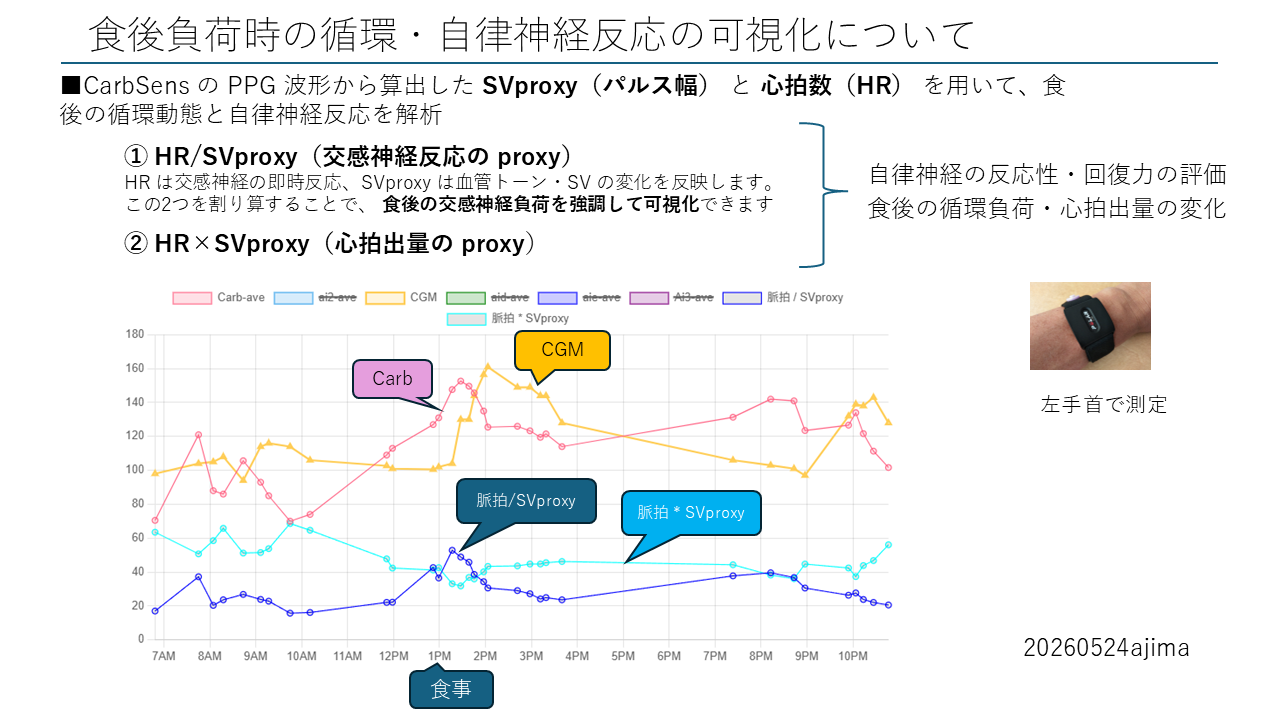
図:心拍出量の変化を可視化、リルタイム時系列で捉えてみよう:自律神経の可視化
体に負荷がかかった時(食後の消化や運動時)、心臓は「HR(心拍数)」と「SV(1回の血液排出量)」の両方をバランスよく、段階的に引き上げます。
老化や自律神経失調、感染症後遺症(Long COVID)があると、負荷がかかった時にSV(送り出す量)が全く上がらない、あるいは逆にガクンと落ちてしまいます。心臓のパニック: 1回に送る量(SV)が増えないため、体全体(特に脳)が「血液が足りない!」とパニックになります。このために、無理やり脈拍数だけが「70➔120」と異常に跳ね上がることがあります。
HR/SVの比率で、この様子を探ってみます。CarbSensではHR,SVは脈波から測定します。ただしSVは直接測れないので代替パラメータSVproxyを使用します。
🟦 Visualizing changes in cardiac output — what HR/SV ratio reveals
Proper cardiovascular control means: When HR increases, SV should rise strongly and consistently. Problems occur when SV fails to follow (or even drops) while HR rises alone — a mismatch indicating stress on the system.There should be a normal, healthy range for this coordination. Further research is needed to define these ranges.
HR/SV ratio = Circulatory Load Index (CLI)
CLI is a unified indicator reflecting both autonomic function and post‑infection dysregulation, capturing “circulatory load” as an integrated measure.🟦 Who benefits from CarbSens?
CarbSens is for anyone who wants to understand their glucose physiology
1. CGM users (with or without therapy)
2. People managing health without CGM
3. Individuals with prediabetes or borderline glucose patterns
4. Sports, fitness, and diet‑focused users
5. Healthcare professionals and researchers
🟦 心拍出量の変化を可視化 HR/SV比率から何がわかるか
正しい制御とは「HRが上がったら、それに合わせてSVも力強くしっかりついていくこと」であり、 これが崩れて「SVが追いつかない(あるいは下がる)のにHRだけが空回りする瞬間」が問題です。どのくらいが正しいのか、正常なのか、適正範囲があるはずです。今後に研究が必要です。
HR/SV比率 = 循環負荷指数(Circulatory Load Index, CLI)
CLI は、自律神経機能と感染症後遺症の双方を “循環の負荷”として統合的に評価できる指標である。🟦 どんな人に役立つか
CarbSens は、血糖を“理解したいすべての人”のためのデバイス
1. CGMユーザー(治療者・非治療者)
2. CGMを持っていない健康管理層
3. プレ糖尿病・境界型の人
4. スポーツ・ダイエット層
5. 医療従事者・研究者
⚠️注意事項 / Important Notice CarbSens Watch/Dualは、日常の健康管理をサポートするためのツールです。本製品は医療機器ではなく、診断、治療、または病気の予防を目的としたものではありません。測定結果や推定値は参考情報としてご利用いただき、健康に関する重要な決定を行う際には、必ず医療専門家にご相談ください。なお、研究目的でのご利用を検討される場合は、所属機関の指針に基づき、適切な手続きをご確認ください。 CarbSens Watch/Dual is a tool designed to support daily health management. It is not a medical device and is not intended for diagnosis, treatment, or disease prevention. Measurement results and estimates are for reference only. Please consult a healthcare professional before making any important health-related decisions.For research use, please follow your institution’s guidelines and confirm any necessary procedures.
Japan Wellness Development Agency (JAWDA)
General Incorporated Association
一般社団法人 日本健康開発機構
Contact us here