CarbSens: A New Approach to Autonomic Function Assessment
Practical, real‑life health monitoring and adaptability evaluation
“Quality of autonomic function”, “response speed”, “signs of aging”
— Autonomic function switching: HR/SV
— Left–right vascular balance: VeST value
CarbSens:新しい自律神経機能評価の提案
実生活に即した健康評価機能・適応力自律神経機能評価
「自律神経の質」「反応速度」「体の老化」
― 自立神経機能評価: HR/SV
― 左右差脈波バランス:VeST値
CarbSens measures pulse waves not only at the wrist but also at multiple sites (CarbSens Dual),
capturing “carbohydrate response” and autonomic–vascular reactions.
This page introduces autonomic “function” and compares CarbSens visualizations—early body signals,
switching ability, and aging patterns—with conventional HRV methods.
CarbSens は、手首だけでなく、複数部位(CarbSens Dual)の脈波を測定し、
「糖質応答」「自律神経・血管の反応」を捉えます。
このページでは、自律神経の“機能”を理解しながら、
CarbSens が可視化する「体の前兆」「自律神経の切り替え能力」「老化の兆候」を
従来方法(HRV)と比較します。
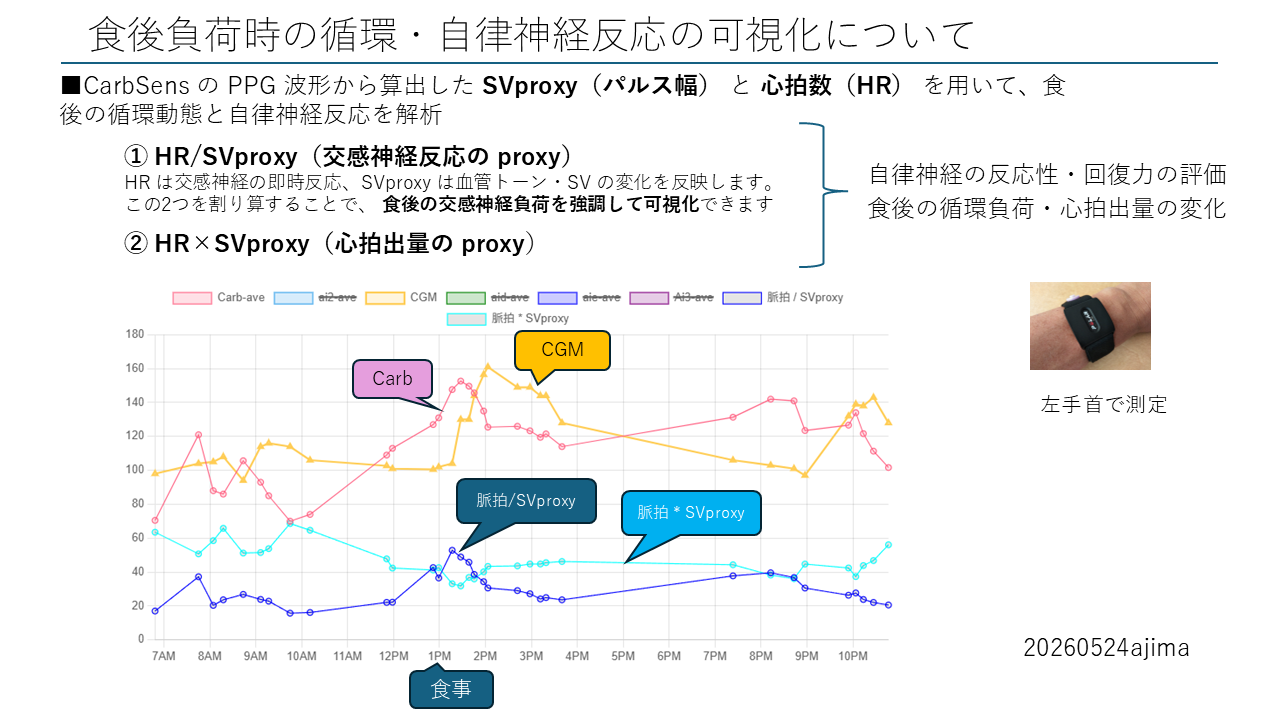
◆ CarbSens can visualize meal‑response adaptability and dehydration.
HR (heart rate) and SV (stroke volume) are controlled by the autonomic nervous system.
After eating, HR rises first, followed by SV. In healthy conditions, these two move together.
When blood volume is low or meal load is excessive, the balance breaks and HR rises disproportionately.
Such patterns may relate to post‑meal hyperglycemia, reactive hypoglycemia, or dehydration.
HR(心拍数)とSV(1回拍出量)は自律神経で制御されていて、例えば、食事をするとHRが上昇し、
続いてSVが上昇します。正常ならば、この2つは連動するのですが、
血液が少なかったり、食べすぎたりすると、バランスが崩れて、HRだけが非常に大きくなる現象が起きます。
この現象をよく見ていきますと、食後高血糖、食後低血糖、脱水症などの症状がわかると考えています。
◆ Using two PPG sensors, left–right pulse balance may reveal vascular asymmetry and early cerebrovascular signs.
Extracting left–right differences may help visualize abnormalities related to diabetic foot circulation
or brain‑origin vascular control errors.
左右差の抽出により、糖尿病性足病変の血流異常、脳由来の血管統制エラーの可視化を目指しています。
◆ Combined with meal‑load testing, autonomic behavior can be revealed more clearly.
Interval measurements (every 5 or 15 minutes) before and after meals allow users to feel
“how the body moves with food” through their own data.
例えば、食事をはさんで、5分刻み、あるいは15分刻みのインターバル測定を行い解析すれば、
「食事とともに、脈波が動く、体はこう動いている」を自分のデータで実感できます。
The mismatch between “felt panic” and actual physiology can be explored.
By overlaying hemodynamic data, reasons for sensations such as sudden cold sweats may become visible.
「体感としてのパニック」のズレが解明できる。
血行動態データと重ねることで、「なぜ今こんなに冷や汗が出るのか」の理由が可視化されます。
🟦 Clear Advantages Over Conventional HRV Analysis
CarbSens’s hybrid method — combining meal load and bilateral pulse waves — offers distinct advantages over traditional LF/HF balance approaches.
■ Dramatically improved sensitivity:
Left–right differences are often subtle at rest and can be missed. Introducing a meal as a “physiological stress test”
reveals hidden autonomic asymmetry and vulnerability.
■ Robust against noise:
Conventional HRV is easily disrupted by breathing or posture. CarbSens evaluates relative changes —
right hand vs. left hand, or post‑meal vs. pre‑meal — allowing calibration that reduces individual vascular stiffness,
respiratory variation, and environmental noise.
🟦 従来法(心拍変動解析)に対する圧倒的な優位性
この「食事負荷×両手脈波」のハイブリッド法は、従来のLF/HF比などのバランス法に対して、 以下の点で開発デバイスの圧倒的な優位性を示します。■「感度」の圧倒的向上: 静止状態で「左右差」を見るだけでは、軽度の自律神経異常は見落とされがちです。 しかし、食事という「負荷(ストレステスト)」をかけることで、潜在的な左右の機能差(脆弱性)が浮き彫りになります。
■ノイズへの強さ: 従来法は呼吸1つでデータが壊れますが、この方法なら 「左手を基準とした右手の相対変化」や「食前を基準とした食後の相対変化」を評価軸にできるため、 個人の血管の硬さや、測定時の呼吸の乱れといった個人差・環境ノイズを相殺(キャリブレーション)しやすい設計が可能です。
| Method | Target / Measurement Time | Benefits / Detectable Trends | Notes |
|---|---|---|---|
| HRV (Conventional) Heart rate variability LF/HF ratio |
Heart (time‑domain) ≥ 2 minutes |
Widely used but sensitive to noise; affected by posture and breathing. Shows balance but not adaptability or vitality. | Camera, PPG, or ECG |
| HR/SV (CarbSens) ★ New proposal |
Whole‑body / metabolism (hemodynamics) 13 seconds |
Meal‑response adaptability / dehydration trends. Post‑meal HR/SV response visualizes autonomic reflex and metabolic errors. | Wrist or palm PPG |
| VeST (CarbSens Dual) ★ New proposal |
Local / brain hemisphere (inter‑site comparison) 13 seconds |
Early cerebrovascular risk (stroke / TIA) trends. Left–right extraction may reveal brain‑origin vascular control errors. ※ TIA: a critical precursor to stroke |
Left and right palm PPG |
| 評価法 | ターゲット/測定時間 | メリット・検出できるリスク | 備考 |
|---|---|---|---|
| HRV 従来法 心拍揺らぎ LF/HF比 |
心臓(時間軸) 測定2分以上 |
一般的だが、心拍変動ノイズに弱く、姿勢・呼吸で変動。バランスがわかるが、身体の適応力や元気度は分かりにくい。 | カメラ、PPGセンサー、ECGなどで測定 |
| HR/SV (CarbSens)★ 新提案2 |
全身・代謝(血行状態) 測定13秒 |
【食事負荷適応能力・脱水】の傾向を捉える。食後の HR/SV 応答から、自律神経反射・代謝エラーを可視化。 | 手首・手の平のPPGセンサーで測定 |
| VeST (CarbSens Dual)★ 新提案2 |
局所・脳半球(部位間脈波比較)測定13秒 | 【脳梗塞・TIAの超早期リスク】に関する傾向を捉える可能性。左右差の抽出により、脳由来の血管統御エラーを可視化。 ※TIA:脳梗塞の重大な前触れ |
左右手の平にPPGセンサーで測定 |
◆ Is measurement site important?
Extremely important — a core strength of CarbSens
The process of blood traveling from the heart to peripheral sites (fingers, palm) is itself regulated by autonomic control, especially sympathetic vascular modulation.Different meanings by measurement site
• Near the trunk (earlobe, etc.): More reflective of the heart’s intrinsic SV variation.• Peripheral (fingertip, palm): Reflects SV variation plus strong sympathetic activity (cold hands, sweating under stress).
Turning “site‑dependent variation” from a measurement disadvantage into an advantage: CarbSens extracts the difference between cardiac factors and peripheral vascular factors.
CarbSens is not a medical device. Use with awareness of individual variability.
Figure: Visualizing stroke volume changes — real‑time autonomic behavior
When the body is under load (digestion after meals, exercise), the heart raises both HR (heart rate) and SV (stroke volume) in a coordinated, stepwise manner.
With aging, autonomic dysfunction, or post‑infection sequelae (Long COVID), SV may fail to rise — or may even drop — under load.This creates a “cardiac panic”: when SV does not increase, the body (especially the brain) senses insufficient blood supply, causing HR to jump excessively (e.g., 70 → 120).
CarbSens explores this pattern using the HR/SV ratio. HR and SV are derived from pulse waves; SV is estimated using a proxy parameter (SVproxy).
🟦 Visualizing cardiac output changes — what HR/SV ratio reveals
Correct autonomic control means: “When HR rises, SV follows strongly and consistently.” Problems arise when SV fails to follow (or drops) while HR alone spikes. The appropriate range of this relationship is a subject for future research.HR/SV ratio = Circulatory Load Index (CLI)
CLI integrates autonomic function and post‑infection sequelae as a unified measure of circulatory load.Figure: Autonomic function visualization using HR/SV ratio
Explanation using HR/SV ratio
CarbSens integrates “glucose‑induced vascular dynamics” and “autonomic response” into a single index (Carb value). This is a physiologically fundamental approach. Carb value and HR/SV can be used together.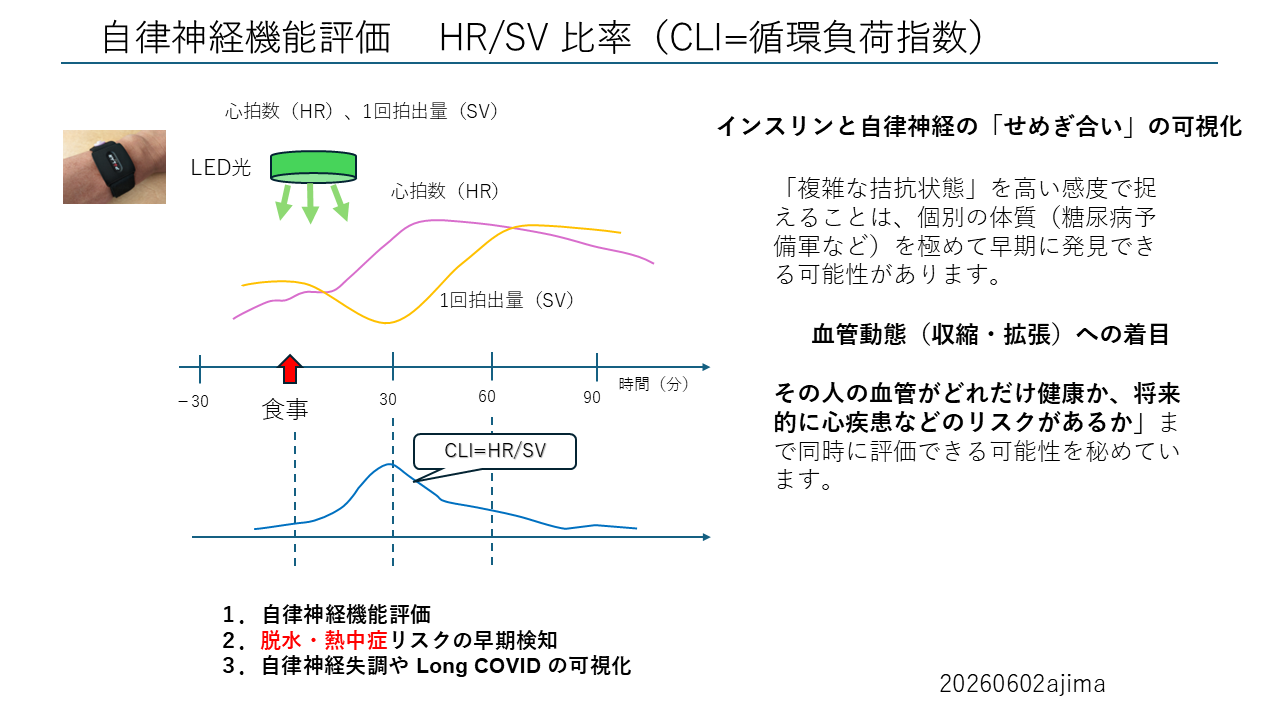
◆測定部位による比較は重要か?
極めて重要、かつデバイスの「独自強み(コアバリュー)」
心臓から出た血液が末梢(指先や手のひら)に届くまでのプロセス自体が、自律神経(主に交感神経)による血管運動調節の結果だからです。測定部位ごとの意味の違い
・体幹に近い部位(耳たぶなど): 心臓本来のSV変動を比較的反映しやすい。・末梢(指先・手のひら): 心臓のSV変動に加えて、「末梢の交感神経活動(緊張すると手汗をかいたり手が冷たくなったりする反応)」が強く掛け算される。
「測定部位で値が変わってしまうこと」を、測定のノイズ(デメリット)とするのではなく、 「心臓因子と末梢血管因子の差分を抽出する」というメリットに反転させることができます。
CarbSensは 医療機器ではありません、個人差を前提にご利用ください。
図:心拍出量の変化を可視化、リルタイム時系列で捉えてみよう:自律神経の可視化
体に負荷がかかった時(食後の消化や運動時)、心臓は「HR(心拍数)」と「SV(1回の血液排出量)」の両方をバランスよく、段階的に引き上げます。
老化や自律神経失調、感染症後遺症(Long COVID)があると、負荷がかかった時にSV(送り出す量)が全く上がらない、あるいは逆にガクンと落ちてしまいます。心臓のパニック: 1回に送る量(SV)が増えないため、体全体(特に脳)が「血液が足りない!」とパニックになります。 このために、無理やり脈拍数だけが「70➔120」と異常に跳ね上がることがあります。
HR/SVの比率で、この様子を探ってみます。CarbSensではHR,SVは脈波から測定します。 ただしSVは直接測れないので代替パラメータSVproxyを使用します。
🟦 心拍出量の変化を可視化 HR/SV比率から何がわかるか
正しい制御とは「HRが上がったら、それに合わせてSVも力強くしっかりついていくこと」であり、 これが崩れて「SVが追いつかない(あるいは下がる)のにHRだけが空回りする瞬間」が問題です。どのくらいが正しいのか、正常なのか、適正範囲があるはずです。今後に研究が必要です。
HR/SV比率 = 循環負荷指数(Circulatory Load Index, CLI)
CLI は、自律神経機能と感染症後遺症の双方を“循環の負荷”として統合的に評価できる指標である。図:自律神経機能評価 HR / SV 比率 自律神経機能の可視化
HR/SVの比率、図を使った説明
CarbSensは「糖による血管動態の変化(末梢血管の挙動)」と「自律神経の応答」という、 体全体のオーケストラのような反応を一つの指標(Card値)に統合しました。これは生理学的に極めて本質的なアプローチです。Carb値とHR/SVはセットで使えます。
🟦 Why does left–right pulse wave mismatch indicate stress?
When strong stress activates the sympathetic nervous system, blood vessels constrict. Under relaxation, left and right vascular tone is nearly equal. Mental stress or chronic fatigue creates asymmetry in autonomic control, producing left–right differences in pulse waves.1. Mental stress — brain asymmetry
Stress is processed slightly differently in the left and right hemispheres. This creates subtle asymmetry in sympathetic output, appearing as left–right differences in palm vascular resistance (pulse wave mismatch).2. Physical stress — posture and muscle tension
Neck/shoulder tension from long desk work or smartphone use stresses the stellate ganglion (autonomic hub). This can over‑activate one side’s sympathetic nerves, causing large left–right pulse wave distortion.Greater asymmetry indicates reduced autonomic resilience and imbalance under stress.
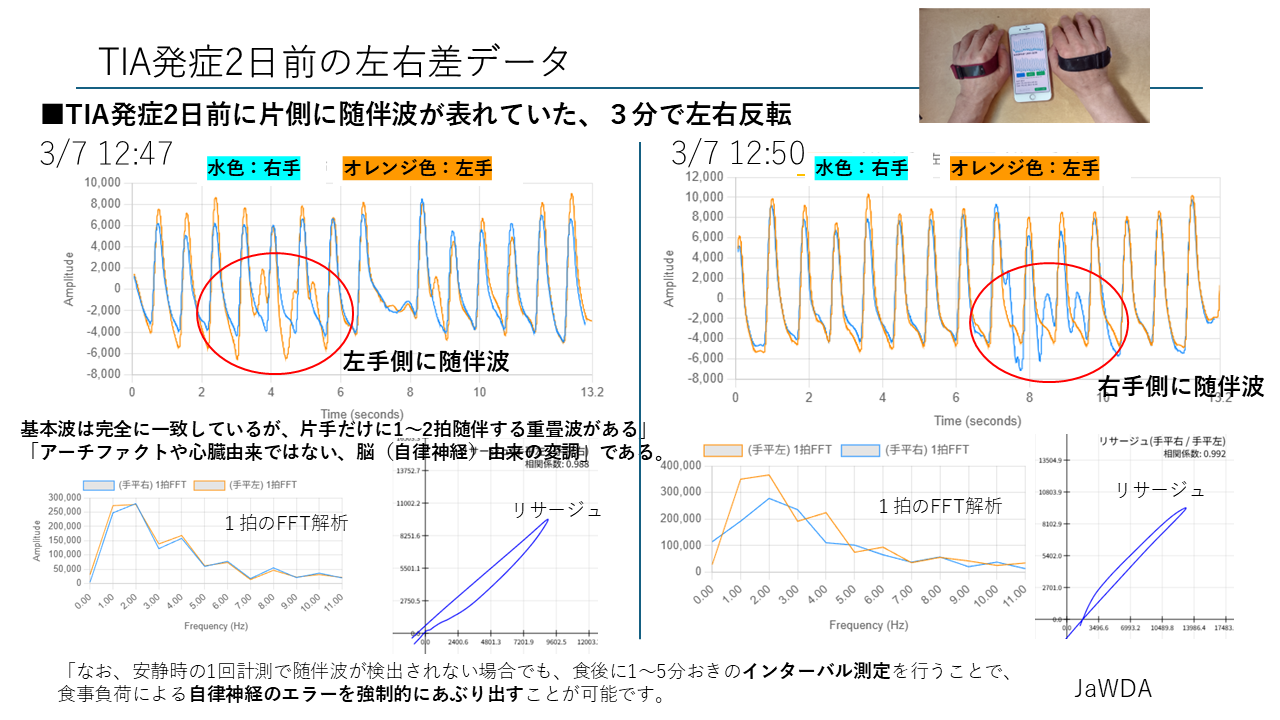
Figure: TIA example — asymmetric pulse waves appearing 2 days before onset
■ The significance of “13 seconds”
A simple palm‑comparison app can engage users with a quick 13‑second measurement each morning.Meaning of combining FFT and Lissajous analysis
This is the most powerful part: instead of simple subtraction, CarbSens evaluates stress using two complementary methods.
① FFT (frequency components)
Physiological meaning: FFT reveals not only the primary cardiac wave but also reflected waves from peripheral vessels. Stress hardens vessels, altering high‑frequency components. Left–right FFT mismatch indicates asymmetric vascular tension — evidence of localized sympathetic imbalance.
② Lissajous waveform (trajectory and correlation)
Physiological meaning: Plotting right‑hand pulse on X‑axis and left‑hand pulse on Y‑axis visualizes amplitude differences and timing differences (phase shift). Perfect symmetry forms a straight 45° line; asymmetry creates an ellipse. Physical stress (neck/shoulder tension, cold hands) causes micro‑second delays, reducing correlation.
Combining “vascular stiffness mismatch (FFT)” and “arrival‑time mismatch (Lissajous)” enables a robust stress score capturing both mental and physical autonomic disturbances.
🟦 なぜ「左右の脈波形がズレる」とストレスなのか?
人間の体は、強いストレスを感じると自律神経(交感神経)が興奮し、血管をキュッと縮めます。通常、リラックスしている時は左右の血管の開き具合はほぼ均等ですが、強い精神的ストレスや慢性的な疲労がたまると、自律神経のコントロールに「偏り(エラー)」が生じ、左右の血管の収縮度合いに差が出始めます。
① 精神的ストレスによる脳の偏り:
脳がストレスを感じる際、右脳と左脳でストレスの受け止め方や交感神経への指令の出し方にわずかな非対称性が生まれます。 それが末梢である「手のひら」の血管抵抗の左右差(脈波形のズレ)として現れます。② 肉体的ストレス(身体の歪み)
長時間のデスクワークやスマホ操作による首・肩のこり(自律神経のハブである星状神経節へのストレス)があると、 片側の交感神経だけが過剰に緊張し、左右の脈波形が大きく崩れます。つまり、左右の波形が「非対称であればあるほど、自律神経がストレスで余裕をなくし、バランスを崩している」という評価が可能です。
図:TIAの図:TIA発症2日前に一方の手の平脈波に随伴波が表れた、3分で左右反転
■ 「13秒」という測定時間の絶妙さ
手軽なアプリ(手のひら左右差)で、毎朝13秒で測らせてユーザーを惹きつける。「FFT」×「リサージュ波形」のハイブリッド評価が持つ意味
① FFT(周波数成分)の比較 生理学的意味: 反射波のエネルギー分布が分かる。 ストレスで血管が硬くなると高周波成分が変化し、左右差は交感神経の局所エラーの証拠となる。
② リサージュ波形(軌跡と相関)の比較 生理学的意味: 振幅差と到達時間差(位相ズレ)を視覚化。 肉体的ストレスで片側の動脈が圧迫されると、マイクロ秒単位のズレが生じ、楕円状に膨らむ。
この「血管の硬さのズレ(FFT)」と「血流到達のズレ(リサージュ)」の2つを掛け合わせているからこそ、 精神的ストレスと肉体的ストレスの両方を網羅した、非常にロバストなストレススコアが計算できている。
🟩 Exploring ultra‑early autonomic changes related to stroke
The insular cortex divides autonomic control between left and right hemispheres. When cerebrovascular disturbances occur, clear left–right autonomic asymmetry can appear. Meal‑load testing may reveal these subtle errors, offering research value for detecting “silent” early risks or predicting cardiovascular outcomes.Four practical research values
1. Exploring ultra‑early autonomic changes before stroke (ischemic or hemorrhagic)
2. Understanding unilateral disorders (migraine, Ménière’s disease)
3. Potential detection of early neurodegeneration (Parkinson’s, MSA)
4. Visualizing mental fatigue and autonomic imbalance (depression, chronic fatigue)
(Non‑medical device; useful for understanding physiological patterns.)🟦 Potential relevance for dementia research
1. Detecting autonomic network disruption in early Alzheimer’s disease
2. Dehydration as a major trigger for delirium — HR/SV insights
3. Links between post‑meal hypotension and cognitive decline
🟦 Autonomic rebound and cardiac risk
Excessive autonomic “left–right rebound” — a seesaw‑like oscillation — may relate not only to stroke risk but also to sudden cardiac events, including heart failure and fatal arrhythmias.🟩脳卒中(脳梗塞・脳出血)の超早期の変化を研究的に捉える試みができるかも
脳の島皮質(インスラ)などは、左右で自律神経(交感・副交感)のコントロールを分担しています役に立つ理由:脳血管障害が起きると、自律神経の統御に明確な左右差が出ることがわかっています。 食事負荷によってこのエラーをあぶり出すことで、 「まだ症状に出ていない隠れ脳梗塞のリスク」を捉えたり、 脳卒中患者の予後(心血管系合併症のリスク)を予測したりする指標になります
4つの実用的な価値
1. 脳卒中(脳梗塞・脳出血)の超早期の変化を捉える探索
2. 特定の片側性疾患(片頭痛・メニエール病)のメカニズム解明と評価
3. パーキンソン病や多系統萎縮症などの「初期神経変性」の検出可能性
4. メンタルヘルスや「脳の疲労(うつ・慢性疲労)」の可視化
(※医療機器ではないが、理解の補助として価値がある)🟦 今回のシステムが「認知症」の検出に使える可能性
1. アルツハイマー病の「脳内自律神経ネットワーク障害」を捉える
2. 「脱水」は認知症(せん妄)の最大のトリガー:HR/SVの活用
3. 「食後低血圧」と認知症リスクのリンク
🟦 心筋リスク(心血管イベント・致命的な不整脈)」につながる非常に重要な視点
自律神経の過剰なリバウンド現象(左右の激しいシーソーゲーム)」は、 脳卒中だけでなく、突然死に直結する心不全や心筋梗塞のリスク予測においても、 極めて強力な指標になる可能性がある。⚠️注意事項 / Important Notice CarbSens Watch/Dualは、日常の健康管理をサポートするためのツールです。本製品は医療機器ではなく、診断、治療、または病気の予防を目的としたものではありません。測定結果や推定値は参考情報としてご利用いただき、健康に関する重要な決定を行う際には、必ず医療専門家にご相談ください。なお、研究目的でのご利用を検討される場合は、所属機関の指針に基づき、適切な手続きをご確認ください。 CarbSens Watch/Dual is a tool designed to support daily health management. It is not a medical device and is not intended for diagnosis, treatment, or disease prevention. Measurement results and estimates are for reference only. Please consult a healthcare professional before making any important health-related decisions.For research use, please follow your institution’s guidelines and confirm any necessary procedures.
お問い合わせ 現在、私たちのプロジェクトは開発段階にあります。私たちのビジョンに共感し、共に新しい価値を創造していただける開発パートナーを募集しています。ご興味をお持ちの方や詳細を知りたい方は、ぜひお気軽にお問い合わせください。
Japan Wellness Development Agency (JAWDA)
General Incorporated Association
一般社団法人 日本健康開発機構
Contact us here